


MOMENTS OF ART: PAINTING WITH WATER
Do you know one of those Buddha boards that is trending right now in the world as a meditative art tool? It is really lovely: you paint with a wet brush on the surface of the board, and as water slowly evaporates, it leaves you again with a blank slate, inviting you to create a new masterpiece. It almost has a therapeutic effect on people: watching something transforming into nothing is a really powerful experience. It teaches us to live and enjoy the moment, focus on the process of doing things and letting them go, whether with their mistakes or unrepeatable perfection.
 Or shall I say rather: it teaches us again? Because the thing is, this is something that children again know instinctively. In our result-oriented world we tend to forget about the joy of just doing things. But if you ever watched a child playing or creating freely, you realise it is actually never about the result but the process itself. Surely, play and art is initiated with an end goal in mind: but that goal is never the main purpose of it. It is rather the activity and the experience itself that fully absorbs our small folk.
What made me realise it some time ago, was actually a little outdoor activity that we came up with our son spontaneously during his first summer holiday. It is pretty much like the Buddha board. Or well, in fact, it is the Buddha board in its pure, original form: painting with water.
The activity, I am sharing with you here, is real simple: you don’t need any expensive things, or even a lot of time to set it up for your child. All you will need is a bucket of water or a puddle after rain, a good brush fitting confortably into small hands, and the world as their canvas. Stone, wood, metal or tile work best as a surface, since the contrast is higher, but you can really experiment yourself with what you have around the house.
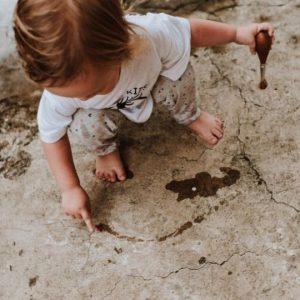
The activity in general leaves a lot of room for exploration and creativity, too, and it is also good for a wide age range. Young toddlers will just enjoy markmaking or splattering the water around, while older children can already explore drawing complex patterns, talk about emotions while drawing faces, or even practice their pre-writing skills. But you can come up together with social games, too: guess the shape, or disappearing tic-tac-toe – why not?
But it is not also their creativity, imagination or early learning that this simple activity can boost. For younger children, painting on big flat surfaces, especially vertical ones is beneficial for several other reasons – something I am planning to write about a bit longer in a seperate post.
Even though we use a lot of art materials at home, I can easily say nothing beats painting with water. It is especially a hit in scorching summer days, but it can be fun any other seasons, too. Just like playing with play dough, it is also something calming to do. It can work wonders on hectic days or when transitioning from energetic activities to quiet time.
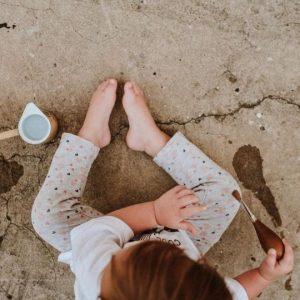
And the good news (to you), that it is really just water, so wherever it finds it way, can’t do much damage. It’s like messy play without the actual mess!
But you don’t need to take my word for it – if you haven’t already, go and give it a try with your children! At first you might be even genuinely surprised how much fun it provides compared to the effort you need to put into it. So it is also a wonderful reminder how little our children actually need for meaningful work and explorations.
Pictures: Jasmina Lozar Photography for Malih nog naokrog. For the pictures we used the Mercurius ergonomic, egg-shaped brushes which fit into young hands and make painting easy.


